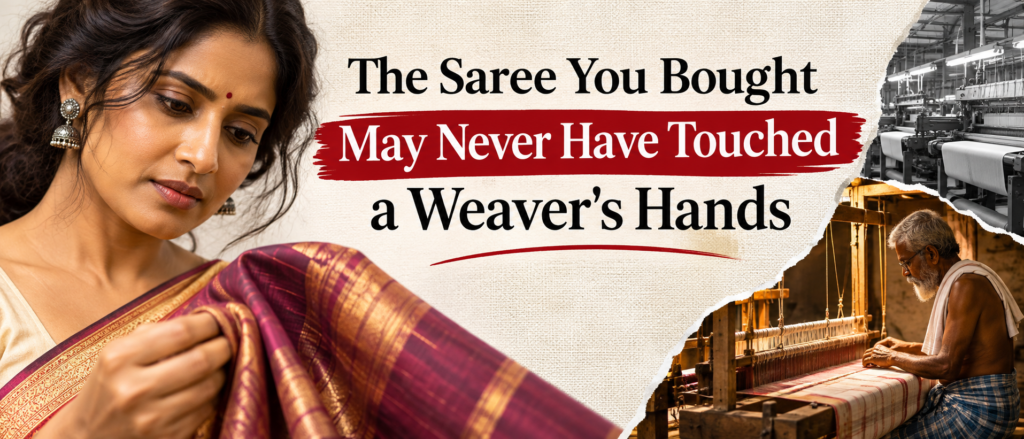
Every year on National Handloom Day, India praises its weavers. Then, on the other 364 days, many of us buy a machine-made cloth with a handloom label on it and feel proud of it.
This is the quiet fraud in our textile market. It cheats the buyer, and it also cheats the weaver.
What is a handloom?
A handloom is a loom worked by human effort. The weaver lifts and lowers the warp threads, which run lengthwise, and passes the weft thread across them, by hand and by foot pedal. No motor drives the weaving. Because the work is slow, the yarn is handled gently. The cloth breathes well and has a natural texture. Each piece shows small differences, because a person made it, not a machine.
A handloom saree or dhoti can take days or weeks to finish. That time and skill are what you pay for.
What is a semiloom?
A semiloom sits between the two worlds. It mixes human work with mechanical help. Some parts, such as pattern work, may still be guided by hand, while other motions are done by the machine. The cloth looks neat and costs less. But it is not a handloom, and a seller who calls it one is making a false claim.
What is a powerloom?
A powerloom is a fully mechanical machine run by an electric motor. It does the lifting, passing and beating of the threads on its own, at great speed. It can make huge lengths of cloth in a day. The result is tight, even and uniform. Cities like Surat, Bhiwandi and Erode make fine and useful cloth this way. Powerloom cloth is honest work when sold as powerloom.
The real problem is the label
Nobody should be ashamed of buying powerloom cloth. It is cheap, strong and useful. The problem begins when it is sold as handloom, at a handloom price.
Here is how the cheat works. A weaver sells a handloom piece for a fair price. A powerloom copy of the same design is made in bulk, at a tenth of the effort. A middleman puts the handloom tag on the copy and sells it at the handloom rate. The buyer pays for craft and receives a machine product. The weaver loses, because the market floods with copies and his real work looks too expensive.
Most customers cannot tell the difference by touch. Some designs are copied so well that even shopkeepers struggle. Honesty cannot depend on a buyer’s eyes.
Why a tag or a certificate is not enough
Paper labels can be printed by anyone. Certificates can be copied. Handloom marks can be stolen. The buyer has to trust a stranger’s word, and that trust is exactly what the cheats sell.
Our answer: a digital passport for every piece
At Save Handloom Foundation, we are building a Digital Product Passport for every handloom product. Each piece will carry a code. When you scan it, you will see who the weaver is, where the cloth was woven, which loom was used, and the story of how it reached you. You will also have a direct link to the weaver, with no middleman between you.
We record this on a blockchain, so that no seller can quietly change the record later.
An honest warning
A blockchain keeps a record safe. It does not prove the record was true when it was first written. If a false entry goes in on day one, the chain will protect that falsehood for ever.
So technology is only half of our work. The other half is verification on the ground. Weaver groups are registered. The first entry is made at the loom, at the time of weaving, with proof that can be checked. Only then does the chain add its strength. A passport is only as honest as its first line.
What you can do
Ask the seller who the weaver is. Ask to see proof. Be careful of a very low price on a “pure handloom” product, because real craft costs real time. And when you pay a fair price to a true weaver, you are not buying a saree or a dhoti alone. You are keeping a family’s skill alive for another generation.
A machine can copy a design. It cannot copy a hand, a name, or a story.
Know the weaver, and you will know the cloth.