Natural Fiber

“Woven Air” : The Cloth the World Forgot to Protect

Three hundred years ago, the finest cloth on earth had names that did not sound like cloth. Weavers near Dhaka called one piece Abrawan, meaning “flowing water”. Another was Baft Hawa, “woven air”. A third was Shabnam, “morning dew”. These were not poetic tricks. They were honest descriptions. Lay such a piece on green grass,

“Woven Air” : The Cloth the World Forgot to Protect Read More »
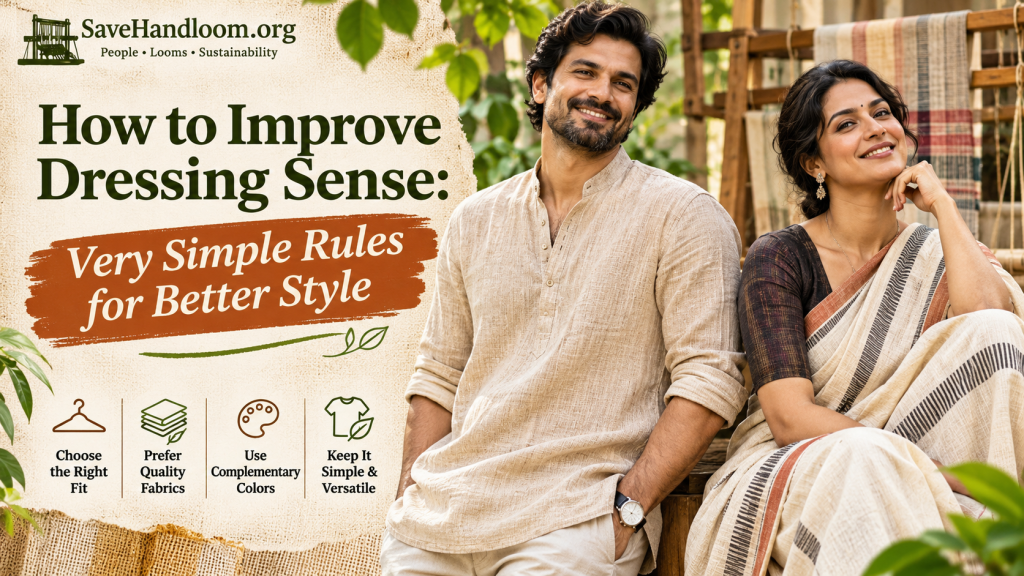
How to Improve Dressing Sense: Very Simple Rules for Better Style

Have you ever looked at someone and wondered, how do they always manage to look so stylish, even when they are wearing something very simple? Well, the secret to good dressing sense is not necessarily expensive clothes, branded outfits or following every new fashion trend. It is about understanding what suits you, wearing the right

How to Improve Dressing Sense: Very Simple Rules for Better Style Read More »

When Powerloom Dresses Up as Handloom: Who Is Really Paying the Price?

A powerloom does not become a handloom because someone draws a few lines over the fabric. It does not become handmade because a seller adds a traditional-looking border. It does not become handloom because the shopkeeper says, “Sir, this is handloom. Trust me.” And yet, this is exactly where thousands of consumers are being misled.

When Powerloom Dresses Up as Handloom: Who Is Really Paying the Price? Read More »

Repair, Resell, Relove: India’s Circular Fashion Era — Or a Circle We Already Broke?

Bengaluru’s Snitch now lets you resell old shirts through Relove. One Less is designing single-fibre basics with a buy-back scheme. VIRGIO is building on recommerce. Canvaloop is spinning textiles out of agri-residue. The headlines are glossy, the founders are articulate, and Gen Z is nodding along on Instagram. Good. Now let us be honest about

Repair, Resell, Relove: India’s Circular Fashion Era — Or a Circle We Already Broke? Read More »

Recycled Polyester vs Virgin Polyester: Are We Really Making a Difference?

In recent years, recycled polyester has been widely promoted as a sustainable alternative to virgin polyester. Fashion brands proudly display labels like “Made from recycled plastic bottles” as if the environmental problem has been solved. At first glance, it sounds like a victory for sustainability. But when we move past marketing slogans and look at

Recycled Polyester vs Virgin Polyester: Are We Really Making a Difference? Read More »

The irony of Indian handloom today: everyone is chasing “mass”… except Mysore Silk

Across India, apex handloom cooperative societies are slowly falling into the same trap. They started as protectors of tradition. They were meant to safeguard weavers, natural fibres, and authenticity. But today, many of them are behaving like ordinary textile shops wearing a “heritage” mask. To survive price wars, they diluted their shelves with: polyester blends

The irony of Indian handloom today: everyone is chasing “mass”… except Mysore Silk Read More »

Lyocell / Tencel: The “Better” Sustainable Fabric — But Still Not the Purest Choice

The fashion industry has a talent for reinventing the same old problem with a new shiny label. First, they sold us polyester as “future fabric.” Then they sold viscose as “plant-based sustainability.” Then bamboo rayon arrived with green packaging and guilt-free branding. Now, the new hero is: Lyocell — often sold under the brand name

Lyocell / Tencel: The “Better” Sustainable Fabric — But Still Not the Purest Choice Read More »

Viscose Sarees & Products: Why They’re Not the Best Choice

🧵 A fact-based breakdown for conscious consumers Viscose is often marketed as a “semi-natural” or “eco-friendly” fiber — but behind that friendly label lie some serious sustainability and health concerns that deserve attention. ✅ 1. Viscose Isn’t Truly Natural Although viscose is derived from wood pulp, the process of turning that pulp into fiber is highly

Viscose Sarees & Products: Why They’re Not the Best Choice Read More »

Khadi Without Gandhi: How a Freedom Fabric Was Hijacked, Diluted, and Sold Back to Us

Khadi was never just a fabric. It was a movement, a political statement, and a moral rebellion against industrial exploitation. Today, it has quietly become something else: a trademarked word, a polyester blend, and in many cases, a well-packaged lie. This is not an emotional rant. This is about how India’s most powerful symbol of

Khadi Without Gandhi: How a Freedom Fabric Was Hijacked, Diluted, and Sold Back to Us Read More »

Why Handlooom.com and DesiFusions.com Are the True Early Movers in Natural-Fiber Fashion

When the world talks about sustainable fashion, a lot of it feels like lip service — recycled materials that are only 20% post-consumer waste, or “eco-friendly” tags slapped onto fast fashion with suspiciously low prices. Meanwhile, every year, millions of tons of polyester (a plastic derivative) are pumped out, dumped in landfills, and washed into

Why Handlooom.com and DesiFusions.com Are the True Early Movers in Natural-Fiber Fashion Read More »