
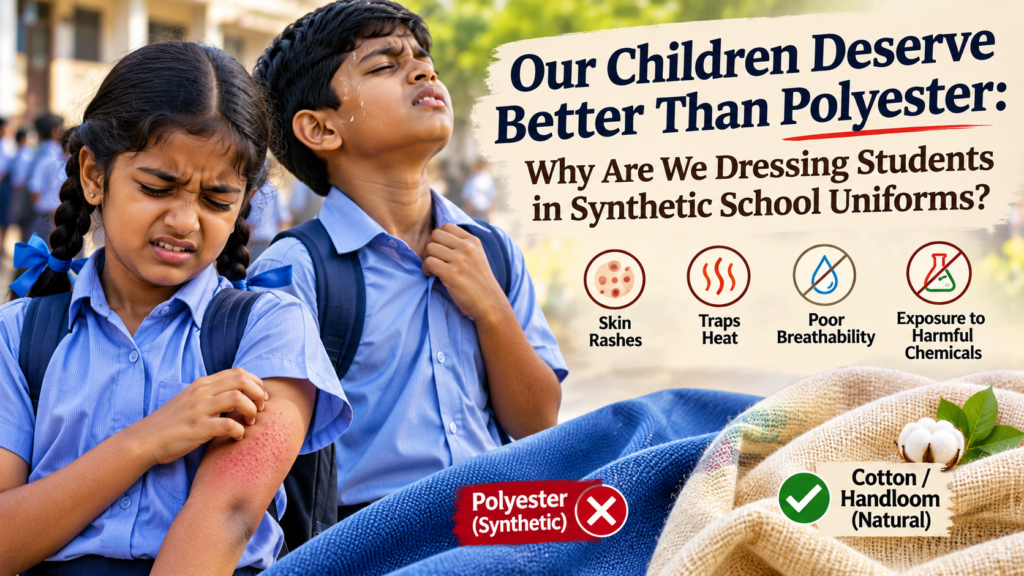
Every morning, millions of Indian children put on a uniform. For many, it is the first thing that makes them itch, sweat and feel uncomfortable. We rarely ask what that cloth is made of.
What happened in Karnataka
In 2022, parents in Gubbi, Tumakuru, received free uniform cloth for their children. They said it was thin and see-through. Complaints came from Mandya and Mysuru too. The Central Silk Technological Research Institute tested the samples and said the fabric met the tender conditions. Parents did not accept this. An official at the institute said the tested samples were different from the ones parents had complained about. The department said they came from the same places.
Later reports showed the problem was wider. Two state agencies were found to have supplied poor-quality cloth in some districts. The Karnataka Cabinet approved a departmental inquiry into poor-quality uniform material supplied by the Karnataka Handloom Development Corporation in 2021-23. A 2026 media report said that cloth supplied in six districts had over 90% polyester, far above the prescribed 70:30 blend. We have not seen the test report behind that figure. It should be made public.
One fact matters most. The government itself prescribes polyester blends for its uniforms. So the issue is not only bad suppliers. It is also a policy choice.
What synthetic uniforms do to children
Polyester is made from petroleum. It does not absorb sweat well. In a warm and humid classroom, sweat stays on the skin. Sweat ducts can block, and prickly heat and fungal infections follow. Cheap cloth may also carry dyes and finishing chemicals. Mixed with sweat, these can cause allergic skin reactions. Dermatologists call this textile dermatitis.
A child cannot take off a uniform in class. Children wear it six days a week, in the Bengaluru heat and the Chennai humidity. Many are too young to explain why they itch.
The private school problem
Private schools often tell parents where to buy uniforms, and the prices can be high. Cloth that costs very little is sold at a heavy margin. Parents pay more and may get a worse product. India has no rule that makes every uniform vendor prove what is in the cloth.
What Kerala shows
Kerala gives free handloom uniform cloth to children in government schools up to Class 7 and in aided schools up to Class 4. The scheme started in 2017 and gives two pairs a year. It helps children and also gives work to weavers.
It has flaws. Weavers have faced delays in wages and yarn supply. But the flaws are about running the scheme well. They are not a reason to drop it. Done properly, one rupee spent on a uniform also feeds a weaver’s family.
What the government must do
- Test every uniform. Government and private school uniforms should be tested by approved labs. Reports should be public.
- Label the fibre. Every uniform must show its fibre content. Parents have a right to know.
- Ban synthetic-heavy uniforms in private schools. Stop schools from selling polyester uniforms at high prices. Move to natural fibre in phases.
- Stop forcing vendors. Parents should be free to buy cotton uniforms from any shop.
- Follow Kerala, and fix its mistakes. Give handloom cotton to government school children free, and pay weavers on time.
Cost will be the main objection. Assam’s education minister has said that cutting polyester makes uniforms more expensive. That is true. But the cost of rashes, doctor visits and lost school days is also real, and families pay it. A weaver’s wage is not a waste of public money.
Our mission
Save Handloom Foundation wants to give 100% natural fibre school clothing, free, to children in Karnataka’s government schools. A child should not have to suffer to attend school. A weaver should not have to give up the loom to feed their family. One cotton uniform can help both.
India wove cotton for thousands of years before the first polyester plant was built. A child’s skin should not be the price of cheap cloth.